how-i-started-in-data-and-ai
- Start with Linux and Python, not theory
- Your time is your most valuable resource; learn what is valuable to you
- Many free resources are available online
I started in data and AI nearly 10 years ago, with no formal experience in coding or software development. I studied a non-CS engineering discipline in college, and flunked out of a mandatory C++ prerequisite course, after several long nights of studying and trying my best.
However, I realized the fault was not 100% my own; rather, it was poor instruction (possibly by design, as the course was a weeder course for new engineers).
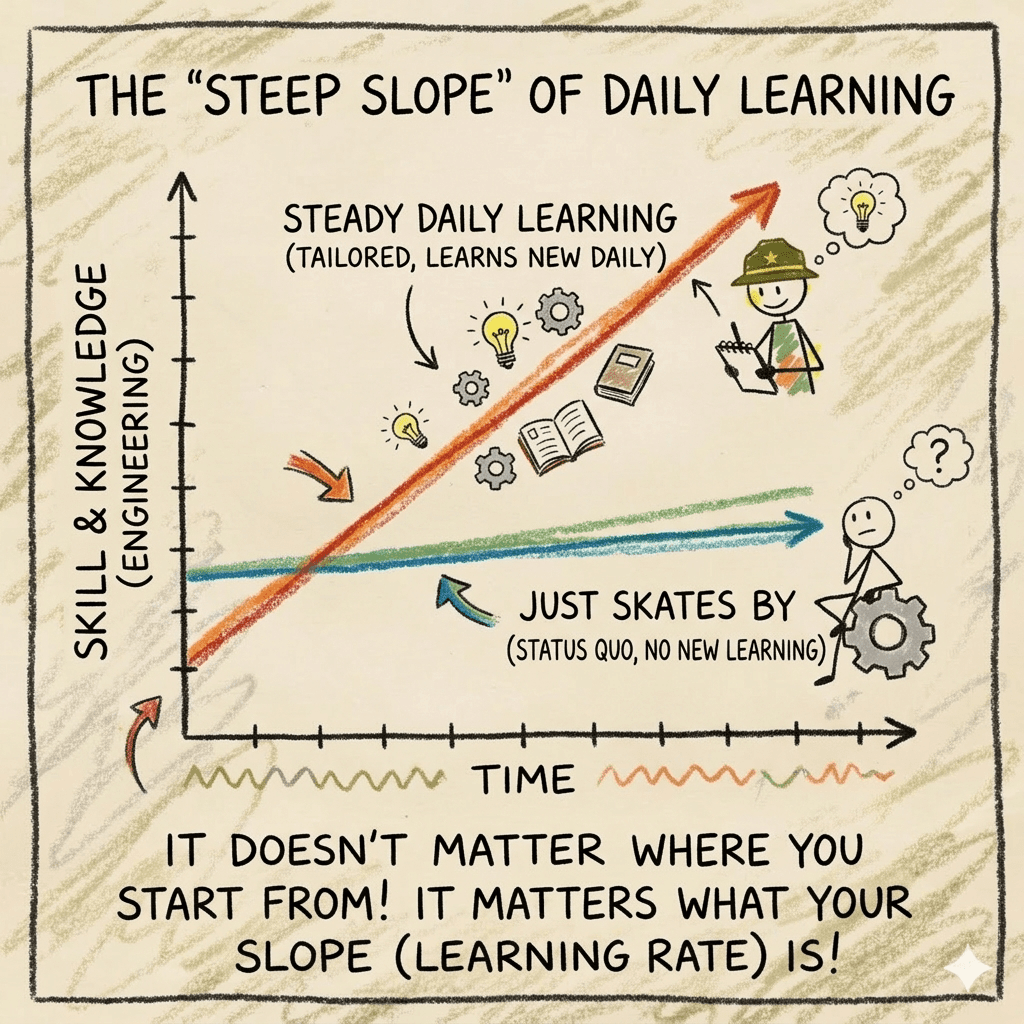
None of that is necessary for you, though. As a software developer, your most important resource is your time, and what I've heard referred to as, your "slope" - e.g., the speed of your learning. You should craft your trade and experience to be exactly, and only, what you deem valuable to your future, and what will increase the steepness of your slope. I'm a higher-level programmer; I'll likely never program in languages like C and C++. My languages are Python and JavaScript, and that's worked out pretty well for me to date.
My Learning Path
Here was my approximate self-learning path:
- Python fundamentals
- Linux fundamentals
- AI/ML and data engineering specifics, in the Python ecosystem
- Containerization and Kubernetes / DevOps / workload orchestration
- JavaScript/TypeScript, and web design (with a focus on React)
If you're not sure what some of those are, don't worry. You don't need to know everything at the start.
Your Learning Path
After 10 years of self-learning and various data / AI positions, I would encourage you to upskill your data and AI expertise using the vast resources available online. Therefore, I've prepared the below course plan.
Feel free to substitute any courses you find - my recommendation is more of a starting point than a strict curriculum!
1. Linux Fundamentals
The building block for all other building blocks. You have to be comfortable working in the shell. This is the starting point of all other software design.
Mandatory proficiencies:
- Git
- Shell scripting
- UNIX/Linux general commands and navigation
Recommended course:
- Hands-on Introduction to Linux Commands and Shell Scripting (IBM, Coursera)
2. Python Fundamentals
My language of choice. You could switch this to Go or TypeScript (or another language used in AI/ML), but Python is a solid choice and one of the best for AI/ML.
Mandatory proficiencies:
- Environment and package management
- Language syntax
Recommended course:
- Python for Data Science, AI & Development (IBM, Coursera)
3. Containerization
Many things run on containers now, as microservices. A solid understanding of containerization technology will bring you far.
Mandatory proficiencies:
- Docker
- Dockerfiles
Recommended course:
- Docker for Beginners with Hands-on Labs (KodeKloud, Coursera)
4. Advanced AI/ML, Data Engineering, and Agentic Software Development
The agentic age is upon us. Some are claiming that coding is being replaced with newer strategies, like Spec-Driven Development, and in the near future, people will not write code, but specifications for agents to use in writing code. They may be right, but having a solid understanding of the underlying principles will still put you ahead.
Mandatory proficiencies:
- AI/ML specific packages
- Agent harnesses (Claude Code, Codex, Kiro, etc.)
Recommended course:
- At this point, you should be comfortable enough with the fundamentals to start learning on your own, using the documentation for the tools you want to use. I recommend starting with the documentation for the agent harnesses, as they are the most cutting-edge tools in this space, and will likely be a big part of your work in the future. Then, use those agents to help you learn the AI/ML specific packages, like PyTorch, TensorFlow, Pydantic-AI, Hugging Face, etc. I'm also available to help you out and soon I'll have a discord server up for the community.
- Kiro Docs (Kiro, free online documentation)
- Claude Code Docs (Anthropic, free online documentation)
- Gemini, Codex, Copilot and other agent harnesses also have documentation available online.
5. Frontend Development (JavaScript/TypeScript) and Web Frameworks
It wasn't until very recently that I learned more about frontend development and how the web works, however, this has been huge for me. I can now share my knowledge by building platforms, like this website. Due to AI, frontend web development has become much more accessible to traditionally "backend" focused engineers.
Mandatory proficiencies:
- JavaScript/TypeScript
- Understanding of the world-wide web
Recommended course:
- Again, at this point, you're able to learn on your own and you should be designing curriculum specific to your needs and goals. I started with MDN Web Development documentation, and then moved on to courses on React and Next.js, which are popular frontend frameworks. I highly recommend starting with MDN's learn modules, and picking a framework from there.
- MDN Learn Web Development (Mozilla, free online documentation)
Search for the courses above on Digital University, many are available at no cost as part of your benefits.
Have questions about where to start, or want to share your own learning journey? Send me a message. I'd love to hear from you.